Showing posts with label heroes. Show all posts

Monday, May 4, 2015

The Shadow of an Archetype

by Simon Blevins


Many heroes have become redundant in their archetypal nature, yet some are unique and break past these roles. Shadow, from the American Gods, appears to be a classic hero with a touch of antihero. Shadow is a newly freed convict trying to return home after years of incarceration.

Upon his release he discovers that his wife is dead. In an attempt to escape his past and find work he embarks on an epic journey through which he explores a world of forgotten Gods struggling to survive in America.

What makes him unique is his incredible maturity.From the start of the story he is a polite individual with a strong control over his anger. This maturity would be less surprising with a stagnant hero; however, he changes a great deal throughout the story.

Shadow starts his adventure with a vague, indirect denial of the world and a lack of closure with his wife's death. His inner change is epitomized when he is hung from the world tree in a sigil to Oden. During this time Shadow looks inwards and comes to terms with his existence. He then rejects the deceptions of the world when he opens the trunk of the car. In the epilogue Shadow cuts the last of his earthly ties in preparation for a death that won't come, concluding his inner change. His development through the story might appear subtle yet it is monumental, I urge any fiction lover to accompany Shadow through the American Gods.

Friday, May 16, 2014

Louis and Lestat: Villains, Anti-Heroes, or Heroes?

by Shadow Dove

Louis was the main character in Interview with a Vampire, and his distaste for his maker, and the way he spoke of him was maybe part of what made Lestat seem like such a villain. At one point early in his new life as a vampire, Louis had this to say about Lestat “And all the time, he belittled me and attacked me for my love of the the senses, my reluctance to kill...and would taunt me with sealed lips when I asked about God or the devil” (Rice 37). It was made very clear that the two were developing a great distaste for one another, and Louis had a suspician that he had only been given the “dark gift” as it is later reffered to, for his plantation and his wealth.

So just because Louis is not as bad as Lestat, does this make him a “hero” or does he rest in the place of “anti-hero” like so many other softer natured Vampires? According to Richard Wilson's article “Anti-Hero: The hidden Revolution in Leadership and Change”, the Anti-Heroes “are inherently sensitive to other people and aware of the limitations of their own knowledhe and skills. It is this sensistivity to themselves, others and the wider world that forms the basis of the Anti-hero” (Wilson 15). This definition clearly fits Louis, he is very sensitive to other people, in fact for many years he refuses to feed on human blood and feeds off of animals instead.

Furthermore, when we look at an excerpt from the Hero's Journey Outline, featured in “The Hero's Journey Outline The Heroine's Journey/ Archetypes 'The Memo That Started It All' by Christopher Vogler 'a Practical Guide to Joseph Cambell's The Hero with a Thousand Faces' by Christopher Vogler”, Vogler describes a hero as “the person who goes out and achieves the great deeds on behalf of the group, tribe, or civilization” (Vogler 1). So although Louis has good intentions and is sensative to the plights of others, he does not by any means have a journey in which he is fighting a cause that serves a “group, tribe or civilization”.

It would appear that by both Wilson's and Vogler's definitions that Louis indeed fits the Anti-hero model. Bleeding heart and all!

Now, Lestat, oh Lestat, what a misunderstood soul indeed. There is no question in my mind that he does not transend from Anti-Hero to Hero, and in fact many times, by his own will, fits quite comfortably into the roll of Villian. However in the second book in the Vampire Chronicles: The Vampire Lestat you see his humanity quite plainly when he is speaking to Armand, an ancient vampire whom he has recently encountered “'You know it was the damnedest luck!' I whispered suddenly. 'I am an unwilling devil. I cry like some vagrant child. I want to go home'” (Rice 242). You have to understand that he had been given the “dark gift” by an ancient who then lept into a fire killing himself, without any explanation of how to live as a vampire, and upon meeting Armand, Lestat had hoped to find answers, but he found none. Instead he learned only that in the words of Armand to “Live among men, and the passing years will drive you to madness” (Rice 201). So perhaps his disapointment and loneliness is what drove him to be villainous, and although he had his moments of making you feel like he could be an Anti-hero, he definitely does not fit into the category of Hero, by any standard that I have found so far. However, I find a fondness for him nonetheless....not only because he is a vampire, but because he is so completely torn between two parts of himself, and I can relate to that. The only difference is that he surrenders to his darkness, and that is what makes him a true Villain.

Wednesday, April 30, 2014

How to Be a Hero

by Anonymous

Everyone has the potential to be a hero. We see opportunities every day. It may not be a calling to bound buildings and save lives, but a simple act if kindness is also heroic. A true hero is someone who sticks up for those who cannot defend themselves. All too many times we see the weak are the ones who are hurt or picked on. It takes only one brave person to correct these wrongs and say something. These people are true heroes and should be acknowledged.

Standing up for those in need is not always easy; we often are afraid ourselves. Or perhaps it’s our nature to turn a blind eye, not wanting to get involved with what's happening. We often think that someone else will say something and stop the abuse, but all too often that is not the case.

You don’t have to run into a burning building to be help someone in need. All it takes is a kind word to someone who looks sad, or a hot meal for a stranger, or maybe even a load of groceries for your neighbor who is going through tough times. These are the things people are going to remember and be grateful for.

Everyone deserves a hero. Are you going to be someone's hero? Next time you see a person in need, stop and think about what might happen if you don’t help. Stepping in and helping could save a life and isn’t that what being a hero is all about? Those who step up and help are true heroes and should be acknowledged.

Sure, being able to stop bullets and leap over tall buildings is what we think of when you mention a hero. It is something we all wish we could do, but don’t forget all those out there that are heroes in their own right. We all get the call to be a hero; are you going to listen? Forget about yourself and do what is right. Be someone's hero.

Heroism is in the Eye of the Beholder

By Anonymous

The definition of a hero is an individual who is romanticized for their valor, nobility, bravery, or exceptional accomplishments. However, are these qualities what truly makes a hero and is the anti-hero closer to the definition of a hero? To just behave bravely with noble and good intentions seems to be closer to a Disney version of a hero.

Often enough there are so many controversies to a conflict that the hero has to make ugly discussions on what is best and how to solve the problem. From my own observations of anti-heroes, their sometimes unconventional methods achieve more good than those who are charismatic and charming who run into battle with their best intentions.

If we have learned anything from our history is that more suffering can come from another’s best intentions.

Is that not what the Christian missionaries believed themselves to be doing to the Native Americans, and the Indigenous people of Australia by taking their children away to the missionary schools, cutting their hair, and applying punishments for speaking their own language.

Did they not believe they were doing something good by killing another’s way of life. With that being the case can not a hero just be a person who is fighting for what they believes is right.

Is not Robin Hood considered to be one of the greatest heroes maybe one of fiction but still a great hero. He, time and time again broke the law against a corrupt government by taking it’s wealth and giving it to the people made poor by their own ruling leadership.

I believe a hero is one of those subjects that is far too complicated and complex to define as one thing, and perhaps heroism is in the eye of the beholder.

Tuesday, April 15, 2014

The Soul of Weaponry

by Leroy Martinez

Contemplating the soul of weaponry is capitalization upon fear that motivates each and every one of us. The Iron Man is an archetype that has been defined in our society through movies and stories. The hero's journey of self transformation models from higher development from mythology and this is a way that humans were believed to think. 

There are many different ways to think about the Iron Man persona and why it is bred into our society as a developed sense of the human being. Industrialization and modernism have changed the way we believe to think, developing us into futuristic human beings. But the gladiator and warrior still linger in all of us in one form or another. This now affects the mainstream population at large. Mindless violence, warlike violence and authoritarian personalities. This was some kind of inhumanity that humans should have conquered in this day and age, but it seems that we are going backwards in time to barbarian ways. Peace is hard work and killing is the coward's campaign as we see in our present day society. Give a soldier or cop a gun and they will us it. 

Heroism comes in many forms and there is an alternative to violence. Iron Man's heart is at the center of this story and is an emerging machine consciousness which is tension between self and persona. Are we afraid that creation will replace the creator? It takes a dramatic event in one's life to make them reflect on what they have become through imperfect, biological, and emotional turbulence.

Sequential art is a part that may give us some insight into our own personal reality. "With great power come's great responsibility," it says in Spider Man. Yet humans still don't know how to contain this.  Take, for example, the ongoing problem of killings and the Albuquerque police department. Worlds of imagination can be useful to give us great insight to the actions that we might take, for instance in The Iron Giant by Ted Hughes is a great example. This is an extraordinary action of humanity by an Iron Man (machine) to save the world by not using his weapons of mass destruction but uses his heart and mind to save the world. This is the possible world that we all want to live in, the perfect world of love and peace.

Friday, April 11, 2014

Still My Hero

By Karen M. Lynn

Robin Hood, in my opinion, falls in to the definition of a hero. I think he would also be considered an anti-hero by others. The simple history of the character is that of stealing from the rich to give to the poor. For the poor that makes him a hero. Stealing makes him a thief and thus anti-hero to those from whom he took.

In the history of the period that the story is set in, the English Kings of the day, Richard the Lion Heart and his brother John, had run the royal coffers very low. That caused them to tax their citizens relentlessly. Historically, people in those days, with exception of the rich, had very little and survival was likely a daily struggle. The common folk could ill afford to support the royal houses. Robin Hood is the man that pilfers from the rich, giving the spoils to the poor and downtrodden; the hero of the day.

The story of Robin Hood is known around the world and resonates still today considering the current financial inequalities experienced by many. I think this tale will always carry some value to those who struggle. May the Hero live on!

Saturday, April 5, 2014

The Hero's Journey in Stories

By Cortnie Gurno

I love movies. The movies I enjoy most are action and adventure. However I like historical movies as well. Movies that use action and adventure to bring a story to life is a great interpretation of that historical event. An example would be the Trojan War and Odysseus and his journey.

I was always intrigued by Greek mythology so studying Odysseus and his journey brought my back to that time. You could never go wrong with Ancient Greece. It is such a beautiful time full of beautiful architecture and stories of Gods, Goddesses and Monsters.

This class is perfect to explore the realms of books and movies. I found that some of my favorite movies were based on books. I am reading The Wonderful Wizard of Oz, which is a great movie but also a great children’s book, one that I never took the time to read. The character of Dorothy is one I feel young women can connect to. Digging deep into her story also lead me to another brave young girl named Alice. Alice in Wonderland is a story of pure imagination and creativity. Both of these stories are well known and popular movies that came from the pages of books. Both characters are heroes in their own journey to find themselves and who they are.

Exploring the model of the Hero’s Journey exposed how many classic stories and tales follow this model. After learning more about the Hero’s Journey I believe this is the key to a successful storyline

Wednesday, April 2, 2014

Heroes Among Us

By Renee Lynda Martinez

I suppose that a hero lies in the eyes of the beholder. I started writing a novel almost 10 years ago and the main character is a vampire who takes the lives of only murderers, rapists, child molesters and animal abusers. I created her from my idea of what a hero would be like. The type of heroine that I would be. This is quite a far cry from the days of my childhood, when I wanted to be Wonder Woman.

As I grew up and grew older, I still had my fantasies of what a hero would be like but the black and white slowly bled into each other and I found that there is a beautiful shade of gun-metal gray that appeals to my senses.

My idea of a hero/heroine is not one, solely, of a super-human dressed in tights, a cape, body armor or who possesses super-human strength or powers - although, that aspect is appealing when presented creatively. I now see heroes who look like everyday people… like you and like me. I see Harvey Milk, a tall, gangly, middle-aged Jewish guy from New York who stood up for the most basic of Human Rights and was murdered in cold blood because of it. His body died but his legacy goes on. I see Malala Yousafzai, a 16 year-old Pakistani girl who also stood up for the most basic of Human Rights and, who was nearly assassinated because of her convictions. She is a living miracle and her legacy has only begun. In both of them, I see the hero that I wish to become. I see that I don’t have to be Wonder Woman or the vampire who exterminates the scum of the earth in order to be someone’s hero. I simply have to speak up for someone who may feel oppressed and inspire others to do the same.

I wear no letter “S” upon my chest but my heart carries the strength of that symbol. I have no Lasso of Truth to use on others… I only use it to speak my truth. My weapons consist of my words, my actions and my intent. When I grow up, I want to be just like Harvey Milk and Malala Yousafzai. I want to be a real Hero.

Monday, March 31, 2014

The Obstacles in a Hero's Journey

By Eliana Lerman
   
What Makes a Hero
A person or fictional character is not considered a “hero” unless they go on a hero’s journey. One can not simply go from point A to point B with no obstacles and retrieve the “treasure” and still gain the same recognition as someone else who faced multiple obstacles and maybe even death, before they successfully completed their journey and returned with the prize. A hero can be a real world hero such as Martin Luther King, or a fictional hero such as Superman. Though the two are vastly different, both types of heroes go through similar stages in their journeys.

Obstacles, Threshold Guardians, and Archetypes
There are often many different people or events that stand in the way of the hero from reaching the goal or treasure. Based on Vogler’s version of the Hero’s Journey, Archetypes are recurring patterns of human behavior, symbolized by standard types of characters in movies and stories. Although there are allies and mentors, the shadows, threshold guardians, tricksters, and shapeshifters tend to be more involved with the hero. The mentors give advice and then tend to disinvolve themselves from the hero’s actual journey. Allies are normally on the outskirts of the journey, fighting whatever other threats they can to protect the hero. On the other hand, the “bad guys” are constantly trying to stop the hero from completing his or her journey, and creating obstacles to do so. Without the obstacles that prevent the hero from an otherwise pleasant and easy journey, the hero would not be considered entirely heroic or brave.

Friday, February 7, 2014

What is a Hero?

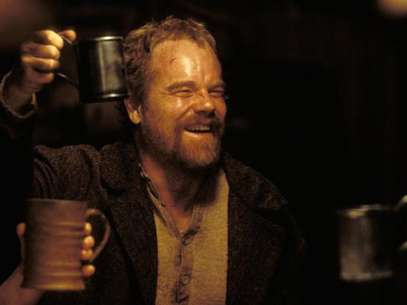
Philip Seymour Hoffman as Rev. Veasey in Cold Mountain.
(NOT a particularly heroic character.)
Strange and melancholy timing that we
started watching this movie in class this week.
This past week there have been many people on the Internet writing about the death of Philip Seymour Hoffman; at the same time, the other big celebrity story has been about Woody Allen getting the Lifetime Achievement award at the Oscars and possibly having molested his adopted daughter when she was a child.

I don't want to dwell or speculate on the details of either story, but what they have both brought to mind for me are questions about celebrity and heroism.  Our culture seems to have a tendency to confuse the two, otherwise we might not be so shocked when we discover that celebrities are often deeply flawed human beings.

So I'd like to look at the definition of the word "hero."  For the purpose of this post I'm offering two distinct definitions (and both are open for debate):
  1. someone with heroic qualities such as courage or honor or altruism, who has demonstrated those qualities through heroic acts that others have benefited from.
  2. the principal character in a story.
Clearly these are very different definitions.  It is the first that comes into question for me when considering the lives of Hoffman and Allen.  These men are not heroes by this definition simply because they are celebrities, nor even because of their talent.  Have these men done heroic things?  If so, have they done "enough" of them to earn them the label of "hero"?  Does death through drug overdose automatically disqualify someone from having been a hero?  Can someone who has molested a child ever be considered a hero?  Why or why not?  Can someone be a hero in some ways and not in others?  Can a villain be redeemed and become a hero? If so, how? Who decides?  

We all have people we hold as heroes in some way; what is it about them that makes them heroes for us?  And how do we react if we see them display less than heroic or even villainous qualities?  

I also want to touch on the second definition of "hero."  From that perspective, everyone is the hero of his or her own story, his or her own "hero's journey."  And yet, to complete the hero's journey cycle as described by Joseph Campbell, the hero has to overcome his or her villainous urges or tendencies and perform some deed(s) that line up with the first definition of "hero."    

Do you see yourself as such a hero?  

To me, it is a heroic act to explore questions like these, beyond the knee-jerk black-and-white responses that might first arise.  Even if we don't come to comfortable, clear-cut answers.  If you have any thoughts on this topic that you'd like to share, please feel free to do so in the comments below.